Modern shisha tobacco production depends on consistency at every stage, from preparing tobacco leaves to mixing, flavoring, and packaging. A Tobacco Cutting Machine plays an important role in this process by transforming whole or partially processed tobacco leaves into precise strips that can move efficiently into subsequent production stages. Consistent cutting can help manufacturers maintain product quality while improving production efficiency and reducing dependence on manual processing.
The Role of Cutting in Shisha Tobacco Processing
Cutting is one of the important preparation stages in shisha tobacco manufacturing. After tobacco leaves have been sorted and dried, they need to be reduced to a suitable size before they can be combined with ingredients such as molasses and glycerin.
The dimensions of the tobacco strips can influence how the material behaves during later processing. Shishapack explains that its cutting system is designed to produce precise strips, supporting the even distribution of flavorings and molasses during subsequent processing.
Rather than relying entirely on manual cutting, manufacturers can use automated equipment to establish a more controlled and repeatable process.
How Automated Tobacco Cutting Works
The basic process begins when whole or partially processed tobacco leaves are introduced into the machine. Depending on the configuration, the material can be loaded through a hopper or transported by a conveyor system.
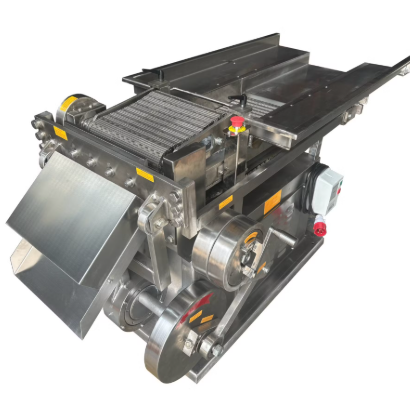
The tobacco then enters the cutting section, where rotary blades or guillotine-style knives shear the leaves into strips. After cutting, an output conveyor or collection tray transfers the processed material toward the next stage of production.
Shishapack’s machines can contain several integrated components, including feeding equipment, an optional pre-cutting mechanism, the primary cutting system, blade cooling, lubrication, an output conveyor, sieves or screens, and a control panel.
This combination allows the cutting stage to operate as part of a larger automated production line rather than as an isolated process.
Why Consistent Cutting Is Important
One of the main advantages of automated cutting is repeatability. Manual processing can produce variations in strip size because cutting techniques and operating conditions may differ.
An industrial cutting system provides greater control over the dimensions of the finished tobacco strips. Shishapack’s machines offer adjustable cutting widths, allowing manufacturers to specify sizes according to their product or batch requirements.
Consistent material can also make subsequent processing easier to manage. When tobacco strips have relatively predictable dimensions, manufacturers can work toward more consistent mixing and flavor distribution.
Production Capacity and Adjustable Settings
Different manufacturers have different production requirements. A small operation may require a lower-capacity machine, while an established facility may need equipment capable of processing significantly larger quantities.
Shishapack lists entry-level, mid-range, and high-performance configurations. Their published capacities range from 100–200 kg/hour for the entry-level category to 350–500 kg/hour for the high-performance category. The QYJ-200 model is listed with a capacity of 100–400 kg/hour.
The published cutting-width range for the category configurations is 1–20 mm, while the QYJ-200 is listed with a cutting length of 2–25 mm. This distinction is important when comparing configurations because specifications can vary between machine categories and individual models.
Materials and Blade Technology
Durability is another important consideration for continuous industrial processing. Shishapack states that the frame and body of its tobacco cutting equipment use food-grade stainless steel, which provides structural strength, corrosion resistance, and a hygienic surface for processing environments.
The cutting system can use hardened steel or tungsten-carbide blades. Optional titanium or ceramic coatings are also available. These materials and coatings are intended to support sharpness, wear resistance, and longer service life.
Regular inspection and maintenance remain important regardless of blade material, particularly when machines are used continuously.
Operator Controls and Safety
Modern processing equipment should balance productivity with ease of operation. Shishapack’s tobacco cutting machines feature a PLC touchscreen interface with multiple language options, allowing operators to control and monitor machine functions through an intuitive interface.
Safety features include emergency-stop controls, protective guards around moving components, and sensor systems that can detect problems such as jams or overloads. Shishapack also states that its machines are designed and tested to comply with EU safety requirements.
These features can help create a more controlled operating environment while supporting continuous production.
Integration With a Complete Production Line
A tobacco cutting machine does not have to operate independently. It can be integrated with other equipment involved in shisha tobacco production.
Shishapack’s broader processing system covers stages including tobacco preparation, cutting, molasses and glycerin mixing, flavoring, dosing, and packaging.
The company’s cutting equipment can also be connected with upstream and downstream machinery to create a more automated production flow. Optional features include dust-extraction connections and noise-reduction insulation.
Customization for Different Requirements
Production environments are not identical, so equipment may need to be adapted to different tobacco types, capacities, cutting sizes, and workflows. Shishapack describes a customization process that begins with requirement analysis and continues through machine design, component customization, manufacturing, testing, delivery, and technical support.
This approach allows manufacturers to consider the cutting machine as part of their overall production system instead of selecting equipment based only on capacity.
Conclusion
A tobacco cutting machine is an important component of an efficient shisha tobacco processing operation. By automating the transformation of tobacco leaves into controlled strips, manufacturers can improve consistency, simplify production, and prepare material for subsequent mixing and flavoring stages.
Features such as adjustable cutting sizes, durable stainless-steel construction, specialized blades, PLC controls, safety systems, and production-line integration can make automated cutting equipment suitable for a range of manufacturing environments. For businesses planning or upgrading a shisha tobacco processing line, choosing the right cutting configuration should be based on production capacity, tobacco characteristics, required strip dimensions, and the requirements of the complete workflow.