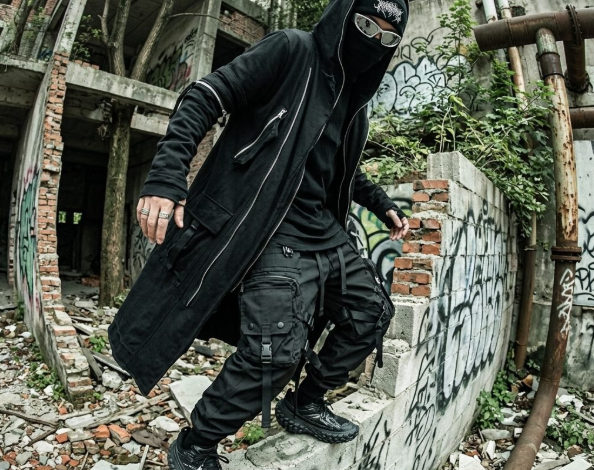
Quick summary: Techwear is clothing built around performance fabrics and modular utility rather than seasonal trends. It borrows from mountaineering, military and Japanese streetwear. The style rules are simple — dark palette, layered silhouette, functional hardware — and the beginner’s mistake is buying the loudest piece first instead of the most wearable one.
The definition, without the mysticism
Techwear is often described as futuristic fashion. That’s the marketing version. The accurate version is duller and more useful: techwear is clothing where the technical specification comes first and the aesthetic follows from it.
A waterproof membrane, a taped seam, a magnetic closure, an articulated knee — each of these exists because it solves a problem. The look people recognise as “techwear” is simply what happens when a garment is designed around those solutions rather than around a silhouette.
That’s why the style reads as coherent even across wildly different pieces. A tactical vest, a hooded scarf and a pair of multi-pocket cargo pants share no visual reference — they share a design logic.
Where it came from
Three lineages converge.
Alpine performance wear. The 1990s brought waterproof-breathable membranes into mainstream outerwear. The technical vocabulary — shells, mid layers, taped seams — comes directly from here.
Military and tactical design. Load-bearing systems, modular attachment, redundancy in pocket placement. This is where techwear gets its hardware language.
Japanese avant-garde streetwear. The final and most important ingredient. Tokyo designers took technical materials and applied experimental cuts — asymmetry, oversized proportions, unconventional draping — turning function into a genuine aesthetic rather than an outdoor uniform.
The four rules that actually matter
1. Restrict the palette. Black, charcoal, grey, muted olive. Colour appears as an accent, not a foundation. This isn’t dogma — a narrow palette is what allows aggressively cut pieces to combine without visual chaos.
2. Build in layers. Base, mid, shell. The layered silhouette is the single most recognisable feature of the style, and it’s functional: layers come off.
3. Let hardware be visible. Buckles, straps, cord locks, exposed zips. In techwear, the mechanism is the ornament.
4. Fit is deliberate, not just loose. Volume is placed intentionally — wide through the leg, tapered at the ankle; roomy in the shoulder, closed at the cuff. Uniformly baggy is a different style entirely.
How to start without looking costumed
The most common beginner error is buying a statement piece first — a full-length cyber coat, an elaborate harness — and having nothing to wear it with. The result reads as costume.
The better sequence is bottom-up. Start with techwear pants: they carry the silhouette, work with clothes you already own, and are the most forgiving entry point. Add a technical outer layer second. Accessories third.
Anyone who wants the harder-edged, more graphic end of the spectrum should look at cyberpunk fashion once the foundation is in place — not before.
What to look for in a garment
Beyond appearance, four checks separate real technical clothing from styling.
Fabric behaviour. Does it move, breathe and recover? Stiff synthetics that look technical and perform like plastic are common.
Pocket logic. Are pockets placed where a hand reaches, or where they look good in a product photo? Pockets you can’t use while wearing a bag are decorative.
Hardware quality. Zips and buckles fail first. They’re the cheapest place to cut cost and the most expensive place to be wrong.
Range of motion. Raise your arms fully. If the hem lifts to your ribs, the pattern wasn’t cut for movement.
Conclusion
Techwear is easy to misunderstand because its most visible examples are its most extreme ones. But the style isn’t defined by helmets and harnesses — it’s defined by a design philosophy where every element earns its place functionally before it earns it visually.
That’s also why it ages well. A garment built around utility doesn’t go out of fashion in the way a trend-driven one does; it simply gets worn until it fails. If you take one thing from this guide, take the sequencing: build the base first, and let the statement pieces arrive once you have something to anchor them to. Start with a single well-cut technical trouser and a shell you’d actually wear in the rain. Everything else follows naturally from there.
Nicolas Falourd, who runs Cyber Techwear, shares brand and industry updates on LinkedIn.