The Buried Backbone of American Property
Across the United States, an enormous amount of essential infrastructure lives underground. Water service lines, electrical conduit, fiber drops, irrigation laterals, and field drainage all share one requirement: a narrow, straight, consistent slot in the earth.
Rural landowners feel this most directly. Stringing power to a barn, running a frost-free water line to a paddock, or burying the bottom wire of a livestock fence all demand a clean channel rather than a ragged ditch.
Municipal and agricultural needs add to the picture. Irrigation districts across the western states lay countless miles of lateral pipe each season, while drainage tile keeps low-lying cropland workable after heavy rain. Every one of these tasks rewards a slot that is straight, sized to the pipe, and consistent from end to end.
For these jobs the trencher has become the practical answer because it produces exactly the slot the work requires without disturbing the surrounding ground.
Understanding Why This Machine Performs So Well
Understanding why this machine performs so well begins not with its specifications but with the simple physics of how it removes soil.
A Chainsaw That Learned to Dig
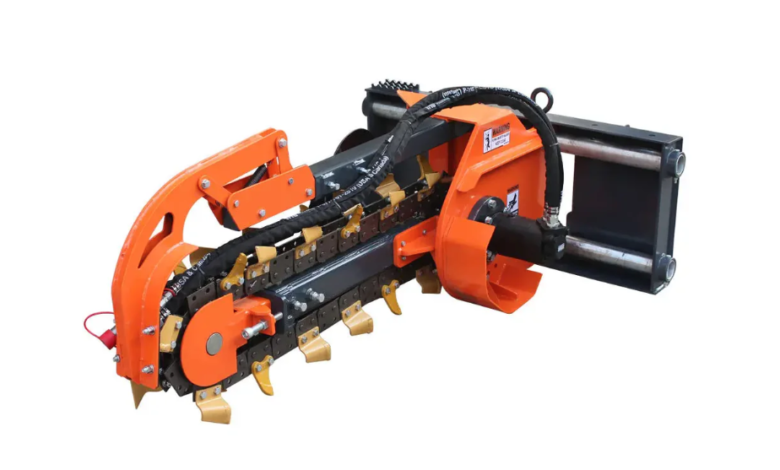
The clearest way to picture the mechanism is to imagine a chainsaw stood on end and aimed downward into the ground. Instead of saw teeth slicing wood fibers, a continuous chain carries dozens of hardened teeth that bite into soil.
Each tooth removes only a small chip. The chain loops endlessly around a steel boom, so cut after cut is delivered in rapid succession, and the slot deepens steadily rather than in heavy jolts.
This is the central principle. A shovel or a backhoe bucket lifts one large scoop at a time, fighting the full resistance of the soil in a single motion. A circulating chain instead divides the work into hundreds of tiny, low-resistance cuts per second.
That division of labor is why a trencher advances through ground that would exhaust a crew working by hand, and why the resulting wall is straight and the depth uniform.
See also: Advantages of Modern Multi-Channel Vehicle DVR Technology
The Conveyor Hidden Inside the Cut
Cutting is only half of the task. Loosened soil, called spoil, must leave the slot or it simply packs back down and stalls the machine.
Here the chain does double duty. The same teeth that carve the bottom of the trench also act as a conveyor, lifting each chip up the boom and flinging it to the surface beside the cut.
Think of an escalator carrying passengers upward while its steps keep forming at the bottom. The loop never stops, so digging and clearing happen as one continuous action rather than two separate steps.
This self-clearing behavior is what allows a single operator to walk steadily behind the unit and leave a neat ribbon of spoil ready for backfilling once the line is laid. Because the spoil lands tidily to one side, refilling the slot afterward is fast and the surrounding turf stays largely intact.
The depth of the cut is governed by how far the boom is lowered into the ground and how slowly the machine advances. An operator who feeds the boom patiently lets each tooth take a full bite, which keeps the engine in its comfortable power band and the trench wall clean.
Two Families of Trenching Machines
It helps to classify these machines by their cutting mechanism because the choice shapes which jobs each handles best.
- Chain machines: a toothed chain around a boom, ideal for narrow, deep utility and irrigation slots
- Wheel machines: a large rotating disc carrying teeth, favored for shallow, very fast surface cuts and harder pavement edges
Chain designs dominate property and utility work because they reach useful depth in a slot only wide enough for a pipe or cable. The eighteen-inch walk-behind class sits squarely in this family, balancing reach against the maneuverability one person can control.
A second classification matters just as much: matching the teeth to the ground. The earth a machine meets decides which cutting edge survives the day.
Why Tungsten Carbide Earns Its Place
Soil is rarely pure soil. It hides gravel, shale, frozen crust, and old construction debris, and every one of these dulls or chips an ordinary steel edge within minutes.
Tungsten carbide is a ceramic-like compound far harder than hardened steel. Teeth tipped with it keep a sharp working face against abrasive ground, so the cut stays efficient instead of degrading into expensive grinding and rubbing.
The intuition is the same as choosing a masonry bit over a wood bit. The harder tip does not muscle through the obstacle so much as it shears it cleanly, preserving both the tooth and the engine that drives it.
Paired with a dependable Kohler petrol engine, a carbide-toothed trencher converts steady horsepower into thousands of small, clean cuts without bogging down when the soil turns hostile.
What the Design Gives and What It Asks in Return
The reasoned case for a walk-behind chain machine rests on a clear trade. In exchange for a single narrow cut, the operator gains speed, straightness, and a slot that needs almost no hand finishing before pipe or cable goes in.
The honest counterweights deserve equal attention. The cut width is fixed, so a wider channel means a second pass, and the rotating chain demands genuine respect during operation.
Stable footing, clear sightlines along the intended path, and confirmed knowledge of buried lines before starting are not optional courtesies. They are the conditions under which a trencher remains a precise tool rather than a hazard. Calling the national locating service before any dig is the single most important step an operator takes.
A Line Across the Back Forty
Consider a common scene on a Midwestern farm. An owner needs to run a water line roughly two hundred feet from a wellhead to a remote stock tank, crossing pasture that hides scattered fieldstone.
By hand, the job is a multi-day ordeal of digging, hitting rock, and re-digging. With a carbide-equipped walk-behind unit, the same path opens in a single afternoon, the stones shorn rather than dodged.
The finished slot is consistent in depth, which protects the line below the frost level, and that reliability is the real reason the trencher has earned a permanent place in rural and utility toolkits across the country.
Seen this way, the machine is less a brute-force digger and more a patient, repetitive cutter. Once its principle is clear, every job it suits becomes easy to recognize.